How Google, Microsoft and OpenAI came to shape what US children learn
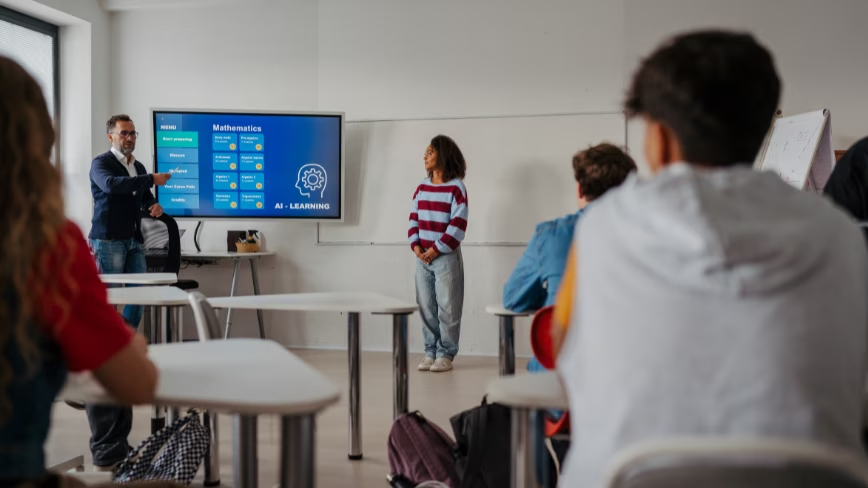
On a humid afternoon in the summer of 2025, Microsoft representatives waited as about 200 teachers filed into a conference hall in downtown Manhattan. The subject was AI chatbots.
The team presented Copilot and had the teachers practise using it to write emails to parents and customise lesson plans. They screened an explainer video from Microsoft’s Minecraft Education division, featuring a cheerful narrator and a cute Minecraft duck.
Natasha Singer was in the room. She published what she found in the New York Times on Sunday.
What the reporting covers
Singer has covered school technology for the paper for more than a decade. The article is an adapted excerpt from her book Coding Kids.
She interviewed more than 100 education and tech industry figures and reviewed hundreds of school, government and corporate documents. A handful of giants have influenced nearly every step of the education supply chain, she concluded.
The comparison she draws
The workshop reminded Singer of seminars she had covered years earlier, organised by drug companies for doctors.
“Industry funds what helps industry,” Adriane Fugh-Berman told her. Fugh-Berman is a Georgetown pharmacology professor who studies drug industry influence on medicine.
Many parents would object if Exxon Mobil wrote their children’s environmental science curriculum, or if Purdue Pharma trained their biology teachers, Singer writes. Schools have embraced the technology industry in similar ways with few questions asked.
The $23m union deal
The day after that workshop, the American Federation of Teachers announced a national programme to train teachers on AI. Microsoft, OpenAI and Anthropic put up $23m.
The union has 1.8 million members. Its president, Randi Weingarten, said the partnership would help educators learn to use chatbots “safely, wisely and ethically”, and get them a seat at the table as the products were built.
Singer put the fox-and-henhouse problem to her. Weingarten acknowledged the dissonance.
“Some of the companies that we’re engaged with are in it for profit,” she said. “Those are two fundamentally different goals.”
One member called it something else
A few teachers and professors warned publicly that chatbots could undermine their profession by automating core tasks, such as marking student work.
Lois Weiner is an education professor emerita at New Jersey City University and a retiree member of the United Federation of Teachers. She argued on Bluesky that the national union was selling out.
“This isn’t an alliance,” she told Singer. “We aren’t sitting at the table. We’re the meal.”
The companies write the courses
Apple offers a free Advanced Placement computer science curriculum teaching high schoolers to code in Swift, its language for iPhone apps. Microsoft offers a competing course, AP Computer Science Principles with Minecraft Education.
Singer makes the point by absence. There is no Raytheon-branded AP physics course, and no Pfizer biology course.
What the companies say
Brad Smith, Microsoft’s vice chair and president, said the dynamic began because public schools seemed ill-equipped to teach modern subjects.
“Philanthropy in the private sector is doing this work because the public sector has failed to do what it’s supposed to do,” Smith said. He allowed that this was not ideal. “It’s not the way we should want public education to work.”
Maggie Johnson, who runs Google’s giving arm, made similar arguments. The company has supplied free coding materials to millions of underserved students, she said.
How Google won the classroom
Chromebooks accounted for 59% of the mobile devices shipped to US schools last year, on Futuresource Consulting figures cited in the piece.
An early campaign called Gone Google helped get there. Schools in nine states later published near-identical handbook lines about how Chromebooks empowered students to reach their potential.
Google agreed to pay $170m in 2019 over regulator complaints that YouTube had illegally harvested children’s data. Millions of schoolchildren have since taken its Be Internet Awesome lessons on privacy.
Learn to code, until they did not need coders
Eric Schmidt, then Google’s executive chairman, told an audience in Scotland in 2011 that British schools were failing to teach computer science. Microsoft issued a similar admonition to the United States a year later, citing an engineer shortage.
The message took off in 2013, when the nonprofit Code.org posted a video starring Bill Gates and Mark Zuckerberg. There were not enough trained people in the system, Zuckerberg said in it.
Funded by Microsoft and Google, Code.org helped convince dozens of states to pass laws boosting computer science.
Software engineers now generate code with AI, and the same companies are pushing schools towards it. This year Code.org renamed itself CodeAI.
The teachers’ own association is uneasy
“In other disciplines, we don’t have industry driving K-12 curricular or policy decisions,” said Bryan Twarek, a vice president at the Computer Science Teachers Association. “And we probably shouldn’t.”
The group represents nearly 10,000 teachers. Its biggest donors include Amazon, Google and Microsoft.
Chromebook remorse
Schools have spent tens of billions on classroom technology over the past decade. Laptops and learning apps have generally not improved educational outcomes, Singer writes.
Los Angeles Unified agreed this year to stop issuing iPads and Chromebooks to students from prekindergarten through first grade.
“Ten years ago, we bought the narrative from the tech companies,” Lila Byock of the parent group Schools Beyond Screens told an LA school board meeting. “Now we know better.”
Weingarten has partly reversed course too. This year she called for elementary schools to hold off using AI with students.
Technology civics
Alicia Streight teaches maths at Edna Brewer Middle School in Oakland. Her weekly class asks students to examine innovations in their lives, from TikTok to meat substitutes to ChatGPT. Who built this, who profits, and how will it affect me in ten years.
Educators have a term for the approach, Singer reports. Technology civics aims to help students navigate Big Tech in schools and beyond.
One school built a traffic light
Cheshire Academy in Connecticut now labels assignments green, yellow or red. Green means AI is fully allowed, red bans it, and yellow lets the teacher permit spell-check but not a chatbot.
Peter Hall reported the system for MIT Technology Review. It grew out of assignments by Miriam Przybyla-Baum, a French teacher who does not use AI herself.
In one, students let a model edit their homework, then decide which edits were correct and which removed their voice. In another, they anonymously grade each other’s AI-assisted work and annotate the parts they think the machine wrote.
Most teachers have no rules at all
Just 18% of US public K-12 teachers said they had received formal guidance from administrators on using AI tools, on Gallup figures cited by Axios.
Governments are filling the gap with limits. A new Iowa law caps digital instruction for K-5 students at 60 minutes a school day. Victoria will abolish bring-your-own-device schemes in primary schools from January, Doosie Morris reported for the Guardian.
Jason Clare, Australia’s education minister, posted this month that there is a good argument children need a digital detox. Madrid cut technology time in primaries this year.
The money has not slowed down
Google is giving students a free year of AI Pro. OpenAI launched ChatGPT for Teens, and investors put $8m into an AI tutor for UK exam students this month.
Fei-Fei Li has argued the real classroom risk is students who stop wanting to learn. Building AI that works in a school is harder than building a chatbot, one founder argued in July.
Nobody has published evidence that traffic lights or screen caps improve results. Schools are trying them anyway.